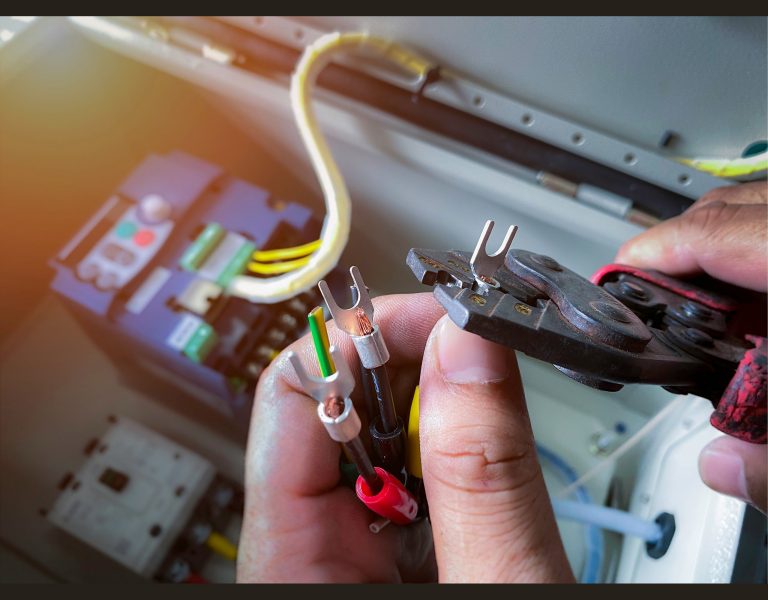
More cost effective than replacement

Inverter repair
Vorteile und Ablauf im Überblick

95 percent of all defective inverters can be repaired

Repair vs. replacement

When is a repair worthwhile

A photovoltaic expert can check whether a repair is feasible and worthwhile. Modern devices are designed so that individual components on inverters can be easily replaced and the repair can be carried out without any problems 

If repair is not possible, the inverter can be replaced with an identical device. Older devices may no longer be produced, but are often still available on the market. Replicas are an alternative. However, the exchange is associated with higher costs.

In most cases, inverter repair is worth it.
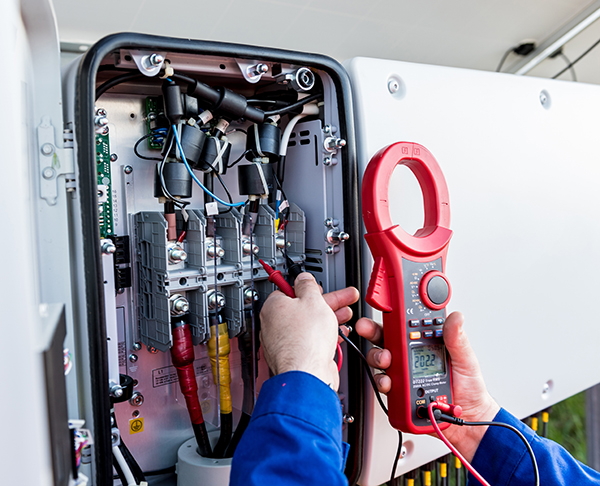
Why is the repair useful?

Repair advantages

An inverter repair has economic and ecological advantages.

For the operator, repair is significantly less expensive than replacement. For experienced technicians, a repair is routine work that is carried out safely and reliably. In addition, repairs are usually completed more quickly than replacement. A longer loss of yield is avoided.

With the replacement of inverters, many tons of electrical waste are generated each year. Repairing them reduces waste. This makes solar power even more sustainable.

Important advantages of the repair at a glance

Ideally, inverters should be serviced regularly,
so that there is no interference.

Error detection

How can malfunctions be detected?

Faults can be detected most easily if an error code is indicated via the display. For early fault detection, the inverter display should be checked regularly.
It is also possible that the inverter can no longer be switched on or that it switches on too late or switches off too early.

Other indications of faulty operation are reduced efficiency or yield of the photovoltaic system. Damage to the inverter often leads to:

  • no feed, 
  • low feed or
  • decreasing feed-in to the power grid.

Frequent damage

What can be repaired?

Inverters are sensitive devices. Even contamination by dust can lead to malfunctions. 

The correct location is crucial for smooth operation of the inverter. Weather and environmental influences must be taken into account during installation. The IP protection class provides information on how well the inverter is protected against water and dirt particles.

In addition to external damage, internal damage can also occur.

Overview of common inverter damage

Troubleshooting

Reparaturkosten

Before a repair, the inverter is checked for the cause of damage. If the inverter can be repaired, the inspection costs are offset against the repair. The repair costs vary depending on the size and cause of damage. Individual components may have to be replaced.

If the inverter is not repaired professionally, a repair involves a safety risk. The warranty claim may also be voided. For this reason, the repair should always be carried out by a qualified technician.

Repair in 4 steps

Inverter repair procedure

Incoming inspection

Defects in the inverter are identified during a comprehensive functional test. The cause of the damage is determined using various measurements. We then check whether the inverter can be repaired.

Cleaning

Inverters become dirty after many years of use. We clean the inside and the housing of the device before we repair the inverter. This ensures good heat dissipation.

Replace components

We replace defective components with new ones. As a preventive measure, we also replace components that already show a high level of wear.

Performance review

Finally, we carry out high-performance tests on the inverter under full load in order to check the function and safety of the new and existing components. A test protocol is created during this process.

Contact your inverter repair expert

Scroll to Top
WordPress Cookie Plugin by Real Cookie Banner